
What are CfD Auctions and Strike Prices?

Written by
Faith Labong
Energy Journalist

Reviewed by
Harvey Rowlinson
Founder and Director, Purely Energy
Published 26 January 2026 · Last reviewed 15 July 2026

Read our blog post about: What Contract for Difference strike prices and auctions mean, how they work, and why they matter for energy prices and consumer bills.
You may be thinking, with so many new developments and the UK’s need to generate more renewable energy, what do government initiatives such as the Contract for Difference scheme actually do? And who benefits, from developers through to consumers?
This blog breaks down how Contracts for Difference (CfDs) works. We'll also explain what the auctions and strike prices mean when it comes to buying and selling renewable energy.
What is a Contract for Difference?
If you've not come across the Contract for Difference before, it's a government-led initiative. It exists to help finance new renewable generation.
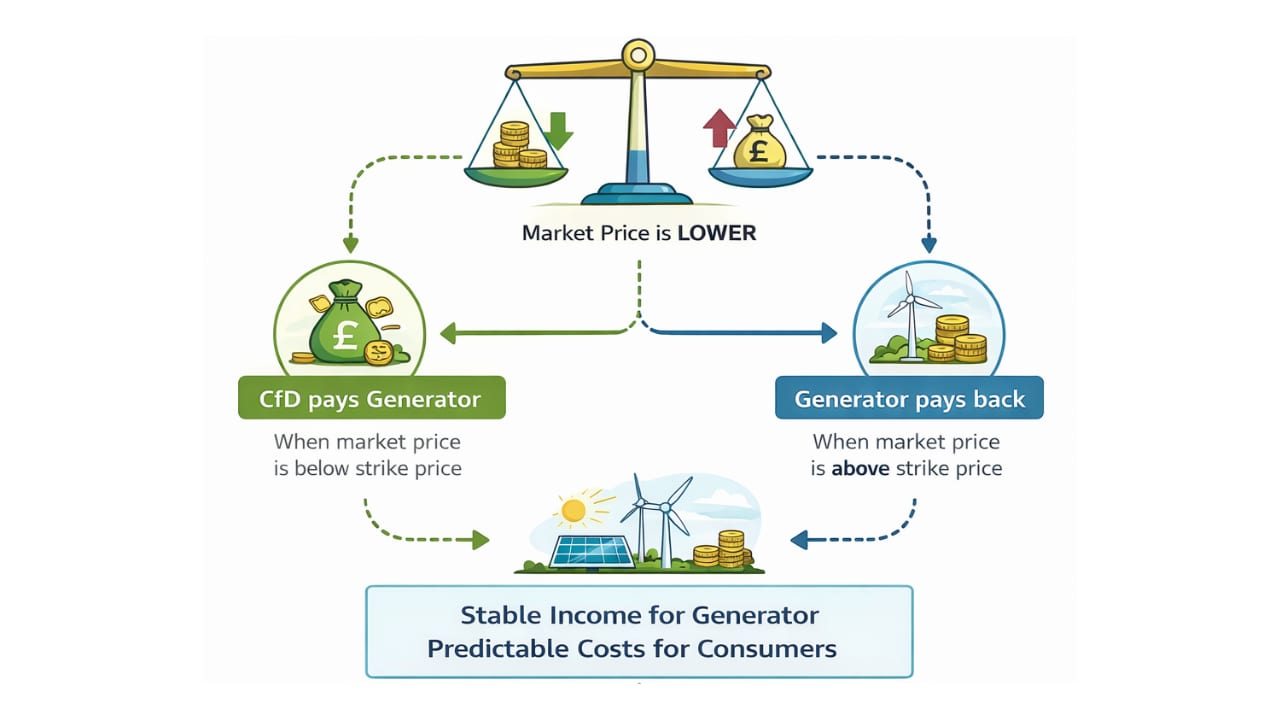
A CfD is a contract between a low-carbon generator and a government-owned counterparty, the Low Carbon Contracts Company (LCCC). It secures long term price stability for both sides. Generators receive a fixed price for each unit of electricity they produce. This is known as the strike price. These deals usually last 15 years.
What does this mean?
Generators sell the electricity they produce into the market as normal. The CfD then comes into play to make sure their revenue meets the agreed strike price. Their income no longer depends on the ups and downs of a volatile energy market.
Strike Price & Reference Price
he strike price is the fixed price per megawatt-hour (MWh) agreed in the auction.
The reference price is a measure of the actual wholesale market price for that technology and time period.
How the CfD adjusts payments
- If the wholesale market price is below the strike price, the CfD pays the generator the difference. This tops up their revenue and protects them from low or volatile market prices.
- If the wholesale market price is above the strike price, the generator pays back the difference. This is an important consumer protection feature. During periods of high power prices, CfD generators return money to the system. That money is used to offset costs on consumer bills.
- The strike price sets the generator's long term income. It also protects consumers from large price swings and excessive subsidy payments.
Why did the UK introduce CfDs?
Before 2014, renewable projects were supported through the Renewables Obligation. That scheme paid generators a subsidy on top of whatever they earned in the market. It helped get the industry off the ground, but it left generators exposed to price risk. It also made costs harder to predict.
The CfD scheme replaced it for new projects. The logic was simple. If investors know exactly what they'll earn for 15 years, lending becomes cheaper. Cheaper finance means lower project costs. Lower project costs mean lower strike prices. Over time, that saving works its way through to bills.
Why are auctions used?
Instead of the government setting strike prices, the UK uses competitive auctions. These are known as allocation rounds.
In each round, renewable developers submit bids. Each bid states the lowest strike price at which they're willing to build and operate their project. The budget is limited, so developers compete against each other. This process reveals the real cost of renewable power. It also pushes strike prices down over time through competition and innovation.
The results haven't always gone to plan. The 2023 round attracted no offshore wind bids at all, because the maximum prices on offer didn't reflect rising supply chain costs. The government raised the price caps for the following round, and offshore wind returned. It was a useful reminder that auctions only work when the parameters keep pace with real world costs.
Why do strike prices matter for your bills?
Strike prices matter for bills in two main ways.
Strike prices matter for bills because they determine the direct cost or saving from the Contract for Difference (CfDs). For example, when wholesale prices are above strike prices, CfD generators return the money, reducing overall system costs and avoiding charging customers high prices for the electricity generated.
Secondly, and more importantly in the long run, CfDs influence the structure of the UK's generation mix.
In wholesale electricity markets, prices are set by the marginal generator, usually the most expensive plant needed to meet demand at that moment. When more wind and solar enter the system, they displace gas-fired generation more often. This pushes the marginal price down, a phenomenon known as the merit order effect.
However, even with higher strike prices, these projects can still benefit the system if they reduce reliance on gas and help stabilise wholesale prices over the long term.
What this means for your business
If your business buys energy on flexible or pass-through contracts, CfD costs already appear in your bills as part of your non-commodity charges.
Understanding how the scheme works helps you make sense of those line items. It also helps explain why a windier, sunnier grid should mean calmer prices in the years ahead.
Talk to the team at Purely
If you need help with your business gas or electricity, get in touch with us!
If you would like a free quote, please fill in the box below, or contact us on 0161 521 3400 or email us at info@purelyenergy.co.uk
© 2026 Purely Energy Ltd. Terms of use.
How we produced this article
This article was human-written by Faith Labong on 26 January 2026 and reviewed by Harvey Rowlinson on 15 July 2026. It is scheduled for its next review on 15 July 2027.
Read our editorial standards and corrections policy.


