
Scrapping VAT on household energy: what it could mean for your bill

Written by
Harvey Rowlinson
Founder and Director, Purely Energy
Reviewed by
Purely Energy Editorial Team
Published 15 September 2025 · Last reviewed 16 July 2026

See how removing VAT and environmental levies from energy bills could impact your business’s future energy costs.
There's talk in Westminster that the Chancellor is exploring a temporary reduction of VAT on domestic gas and electricity, from 5% to 0%. The idea has appeared in pre-Budget briefings as a quick way to give households some headroom on costs.
This would show up directly on bills as a small but immediate saving. It would sit on top of whatever Ofgem sets each quarter through the energy price cap
An overview to the proposal
What’s being considered?
A cut in VAT on household energy to 0%. HM Treasury would need to legislate, and suppliers would pass the change through to customers’ bills.
How big is the saving?
Roughly £88 a year for a “typical” user at today’s cap. Using Ofgem’s typical domestic consumption values as the yardstick; your actual saving scales with your own usage profile and tariff.
Who’s covered?
Households only.Business bills aren’t affected by a domestic VAT change, so companies should continue to focus on procurement strategy and usage reduction.
What else is on the table?
Ministers are also said to be looking at shifting some policy and green costs off bills. For an average household, that could be worth around £200 or more a year. However, it would require decisions across HM Treasury and the Department for Energy Security & Net Zero (DESNZ), and may come with fiscal trade-offs flagged by the Office for Budget Responsibility (OBR).
Energy price cap — Typical household energy bill
Purely Energy view
Source: Ofgem • Chart rebuilt by Purely Energy (illustrative, based on public figures).
Why this matters now
Bills are lower than the 2023 peak. But, as Ofgem's cap updates keep reminding us, they're still materially higher than pre-crisis levels. Arrears also remain elevated, according to charities such as Citizens Advice and think tanks like the Resolution Foundation.
A VAT cut is one of the fastest levers the Government can pull. It requires minimal system change from suppliers. It also creates a visible reduction that consumers can understand without decoding complex tariff mechanics. In short, a 5% discount from what they were paying prior.
On the image below, the £88 VAT would be cleared completely from invoices. It is also worth noting the £198 of policy costs per annum set by the government. These could also be cut heavily to reduce bills.
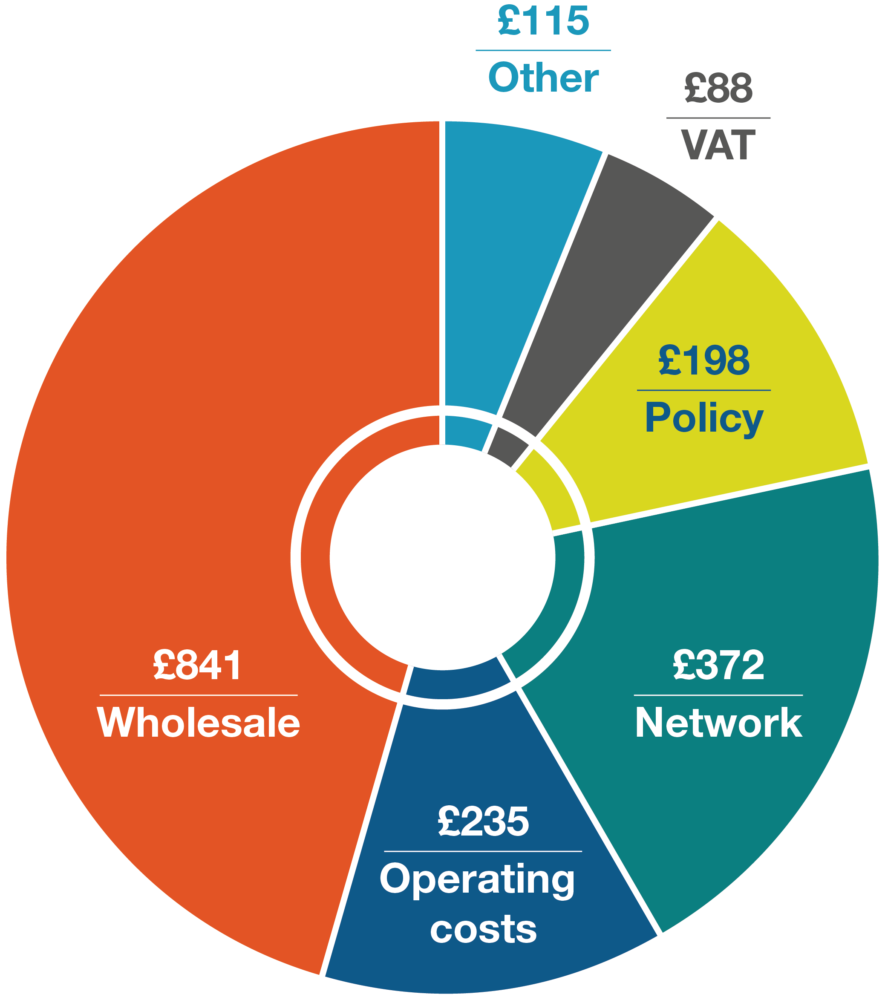
How your savings would really work.
Ofgem's cap uses Typical Domestic Consumption Values (TDCVs) to illustrate what a "typical" household might pay, but no one is truly typical. Use less than the TDCV and your saving shrinks below £86; use more and it grows.
Importantly, unless the Government also reforms standing charges, which Ofgem regulates and which network operators and policy costs feed into.
You should expect the VAT change to apply only to the unit-rate and standing-charge VAT elements as they exist today, rather than a wholesale redesign of what you’re charged.
What wouldn’t change (at least for now)
Even if VAT is cut to zero, the price cap will still move quarterly as Ofgem reflects wholesale markets, policy costs and network charges.
The energy market design, overseen by Ofgem and, where relevant, the Competition & Markets Authority (CMA). Would carry on as is, so any relief from VAT would sit alongside whatever the next cap calculation brings.
A domestic VAT change wouldn't touch Business tariffs. Reforming standing charges or policy costs would need DESNZ, Ofgem and the network companies to agree. The Treasury would also have to sign off the funding.
Prosandcons
Pros: quick to deliver, easy to understand, and it helps every home immediately without complex eligibility tests.
Cons: It's costly for the public finances and poorly targeted at those in the deepest difficulty. Nor does it fix the structural drivers: network costs, wholesale gas volatility, or the way standing charges hit low-usage, lower-income households.
What to do next
Households: keep readings up to date, use your supplier’s usage tools, and attack easy wins - heating schedules, insulation, LEDs, and appliance run-times.
Businesses: A domestic VAT cut won't affect most business bills. It only matters for organisations already on the domestic 5% rate rather than 20%, such as charities, care homes, schools and hospitals.
Work with Purely Energy
Want a clear, numbers-first plan? Whether you're a multi-site group or an SME, we'll map your contracts, consumption and standing charges against Ofgem's latest methodology and design a route to lower costs and risk.
Get in touch with us on 0161 521 3400 or info@purelyenergy.co.uk and we'll start with a short, no-jargon plan of action as soon as possible for your business.
© 2026 Purely Energy Ltd. Terms of use.
How we produced this article
This article was human-written by Harvey Rowlinson on 15 September 2025 and reviewed by Purely Energy Editorial Team on 16 July 2026. It is scheduled for its next review on 16 July 2027.
Read our editorial standards and corrections policy.


